
Electrical Planning Report (EPR):
What It Is and Why You Need One
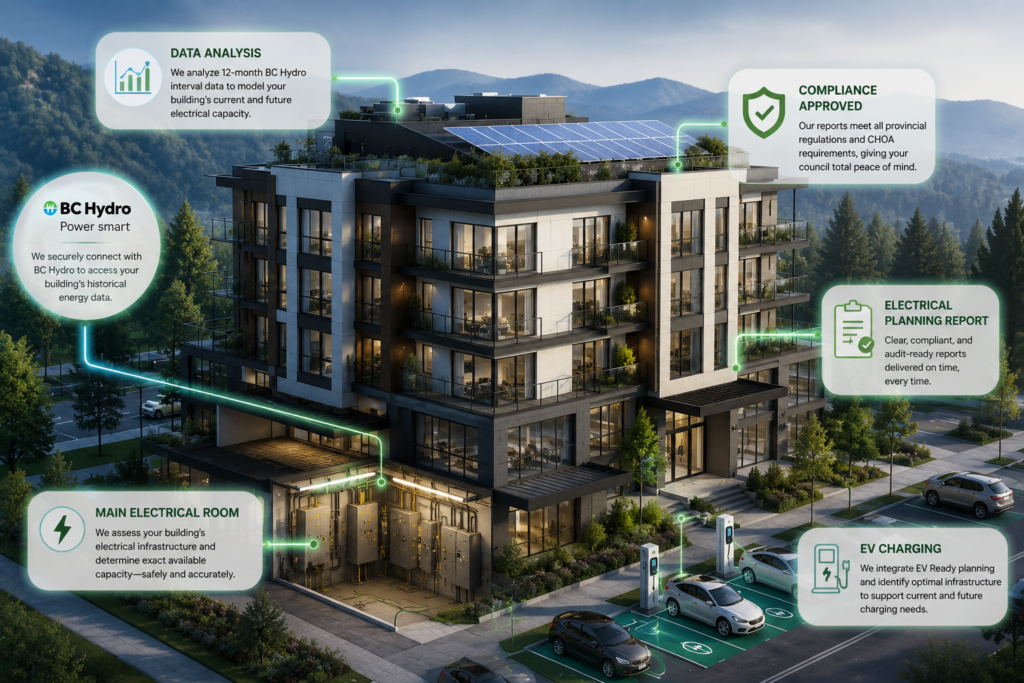
What is an EPR?
An Electrical Planning Report checks how much electrical capacity your building has right now and whether it can handle what's coming. More EV chargers. More heat pumps. More load on the system. This report tells you where you stand and what you need to fix before it becomes an emergency.
Think of it like a load test for your building's electrical backbone. Skip it, and you risk finding out your panel can't handle a new EV charger install the hard way mid-project, over budget, and behind schedule.
Why do you need one?
BC's Strata Property Act requires it. If your strata has 5 or more units, you're on the hook to get this report done. The province wants buildings ready for where energy demand is headed, not scrambling to catch up after residents start installing EV chargers and heat pumps on their own.
Skip this step, and you're looking at overloaded panels, blown breakers, or a building that just can't keep up. None of that is cheap to fix after the fact.
What's in the report?
Three things:
- Where you stand today a full check of your building's current electrical capacity.
- Where you're headed a forecast of future power needs, covering heating, cooling, and EV charging.
- What to do about it clear, specific upgrade recommendations so your system can handle the load without breaking down.
How does it get done?
Our engineers and technologists walk the building, check the existing electrical system, and map out what future demand will look like. Then they put it all together into one report built for your building not a generic template.
You walk away with a clear action plan. No guesswork. No surprises down the road.
Why this matters to you
Energy demand isn't slowing down. Buildings that don't plan ahead end up paying more later emergency upgrades, unhappy residents, and rushed contractor work under pressure. Get the EPR done now, and you avoid all of that. You protect your building, keep residents happy, and stay ahead of the curve instead of playing catch-up.
Deadlines mark your calendar
If your strata was set up before December 31, 2023:
- Metro Vancouver, Capital, and Fraser Valley regions: Report due by Dec. 31, 2026
- Everywhere else in BC: Report due by Dec. 31, 2028
New strata developments: You've got 5 years from the date your strata plan was filed to get this done.
Don't wait until the deadline is on top of you. Get this scheduled now, while you've still got room to plan the work properly instead of rushing it.
Hanna Energy Inc. is an independent consulting, procurement, and construction management (EPCM) firm specializing in clean technology and compliance reporting across British Columbia.
All content is aligned with the British Columbia Strata Property Act (Section 94.1) and updated CHOA structural guidelines.
Hanna Energy Vetted, Licensed, and Fully Insured
We operate with complete corporate transparency. Our qualifications meet or exceed all provincial regulations and CHOA guidelines.
- BC Hydro Alliance Member: Authorized to coordinate directly with the utility to securely extract and process complex building load data.
- HPCN Registered Member: Fully certified within the Home Performance Contractor Network. This status is strictly required by BC Hydro as of June 1, 2026, to qualify your building's future solar and battery installations for up to $20,000 in rebates.
- Consulting E&O Insurance: Backed by specialized professional Errors and Omissions insurance. This protects your strata council from financial liability during mathematical load forecasting, a coverage standard electrical contractors rarely carry.
- WorkSafeBC & Electrical Licensing: Fully covered by WorkSafeBC with active, valid British Columbia electrical licensing for safe, fully compliant site field audits.
How the 2026 Mandate Affects You
Please select your role below to see how our turnkey EPCM (Engineering, Procurement, and Construction Management) process simplifies your compliance path.
Our Low-Friction Compliance Path
We do the heavy lifting while your council sits back and relaxes.
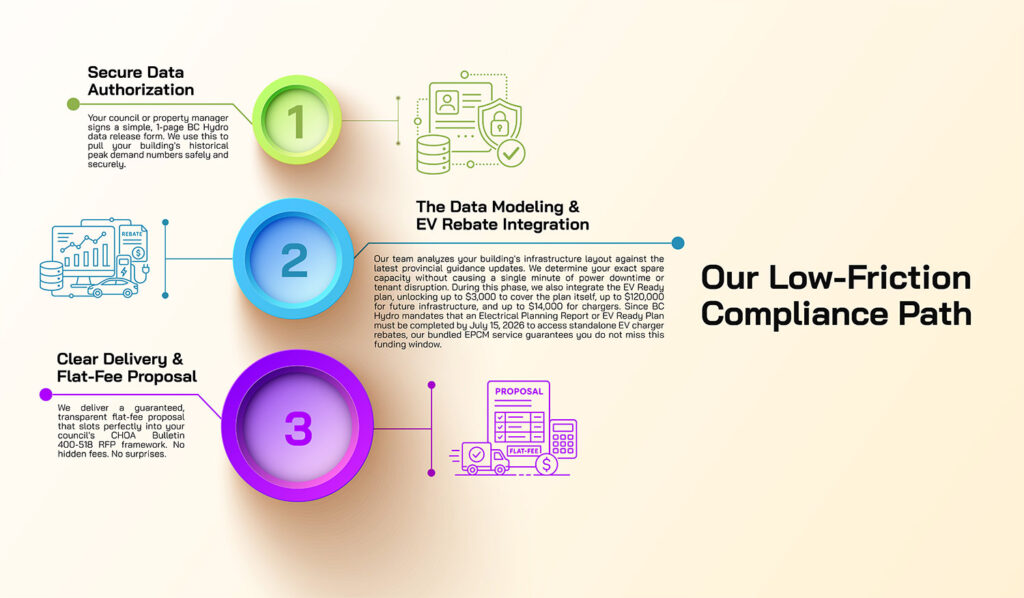
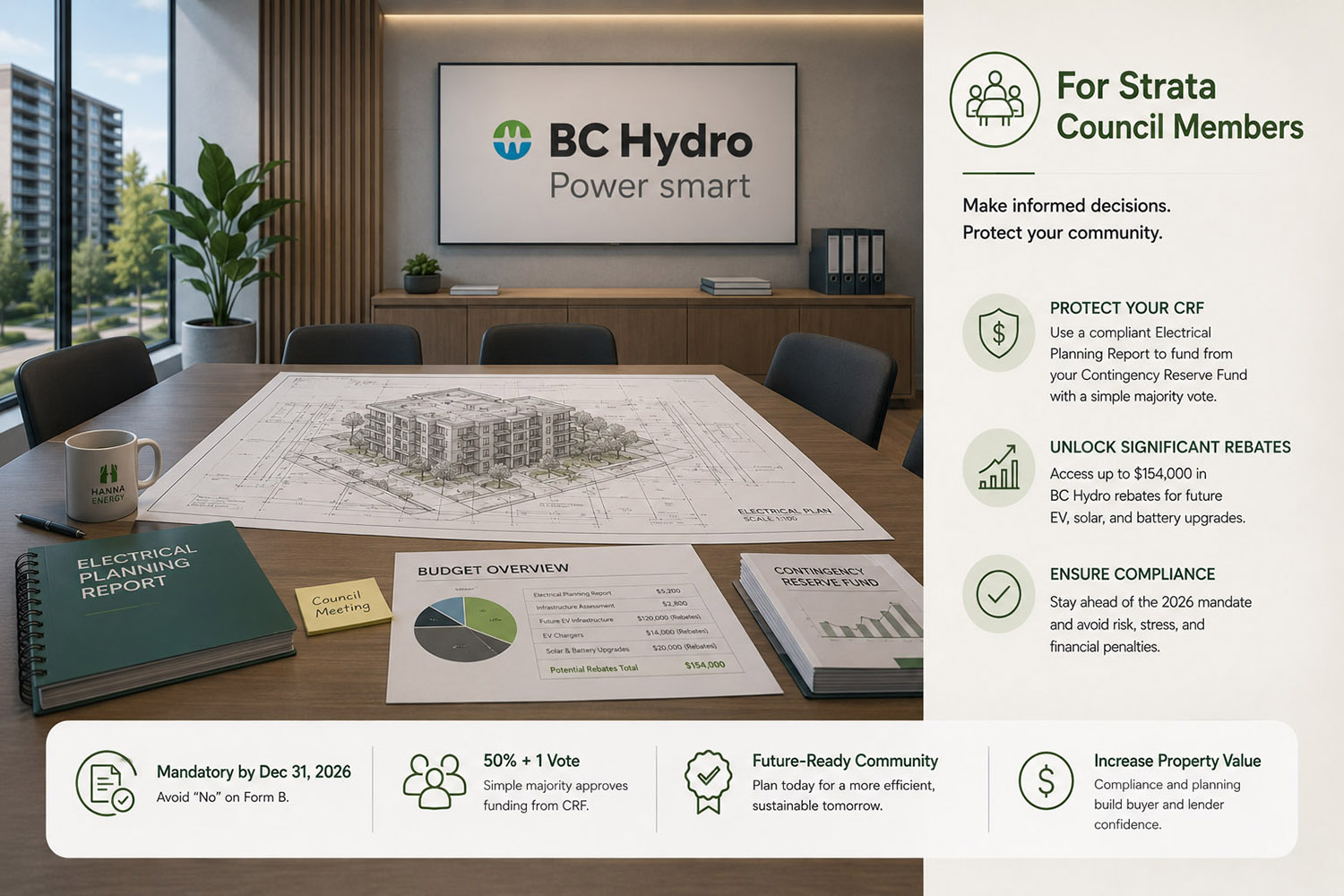
Protect your building's Contingency Reserve Fund. Learn how our unique position as an HPCN member allows us to design your report to unlock up to $20,000 in future BC Hydro rebates for solar and battery upgrades. Furthermore, EV Ready rebates offer a maximum of $137,000 in funding per apartment, condo or townhome complex. This funding is broken up across the plan, infrastructure and chargers: up to $3,000 for the EV Ready plan, up to $120,000 for EV Ready infrastructure, and up to $14,000 for chargers. Beginning July 15, 2026, you will need to have completed an Opportunity Assessment, Electrical Planning Report or EV ready plan to apply for the standalone EV charger rebate. Plus, use the new legal voting loophole: you only need a simple majority vote (50% + 1) to fund this mandatory report directly from your CRF.
Faq
An Electrical Planning Report, or EPR, serves as a thorough energy audit and electrical health check for multi-family residential complexes. The government of British Columbia introduced this requirement to confirm that aging townhouse structures and condominium buildings possess the necessary capacity to support modern electrical demands, such as electric vehicle charging infrastructure and advanced heating or cooling systems, without creating risks of overloading primary electrical infrastructure. The assessment involves a comprehensive analysis of the existing electrical distribution limits of the property coupled with an evaluation of the previous 12 months of electricity consumption data to provide the strata council with a clear technical roadmap.
Yes, completing an EPR is a strict statutory requirement enacted under amendments to the British Columbia Strata Property Act. Strata corporations do not possess the legal authority to vote against this requirement, issue liability waivers, or opt out of the regulation under any circumstances, regardless of when the complex was constructed or how its buildings are configured.
No, the EPR does not represent an annual recurring cost. Following the initial delivery of the comprehensive baseline document by Hanna Energy, the Strata Property Act establishes that the report must be updated or refreshed once every five years to reflect any subsequent infrastructure modifications or load additions.
The total financial investment is determined entirely by the physical dimensions of the building, the total number of utility meters, and the specific configuration of the electrical panels. Hanna Energy delivers customized, competitive flat-fee project pricing structured for everything from small townhouse developments to expansive multi-family towers. Contact our team directly for a precise project quote.
While the provincial government does not offer direct subsidies for standalone compliance reports, substantial BC Hydro utility rebates are available if your property lacks an existing parking infrastructure strategy. Hanna Energy specializes in combining the mandatory report with a formalized EV Ready Plan, enabling us to apply for utility programs that significantly lower our overall assessment fees.
The strata council can fund the project through the standard Operating Fund by integrating the expense as a specific line item within the annual operating budget, or by withdrawing the necessary funds directly from the Contingency Reserve Fund via a standard resolution voted on by the ownership group.
No, the provincial government reduced the statutory voting threshold to expedite compliance across British Columbia. If the capital required for a mandatory electrical report is drawn directly from the Contingency Reserve Fund, only a simple majority vote is needed to approve the corporate resolution.
Under existing British Columbia regulations, a strata council cannot unreasonably deny an owner's structural request to install an electric vehicle charging station if the owner takes responsibility for all associated installation costs. The electrical report equips the council with the necessary engineering data to oversee these installations safely.
Simply reach out to our consulting division to request our quick building intake questionnaire. Our team manages the subsequent administrative tasks, guides your council through the utility authorization paperwork, and provides a clear, comprehensive project proposal structured for immediate review at your next corporate meeting.
Yes, we do not simply deliver a dense technical document and exit the project. Upon completion, our consulting staff can attend your next council session to present the finalized report, translating complex electrical calculations into clear, actionable financial strategies for the owners.
Yes, starting June 1, 2026, all solar panel array installations and battery storage projects must be executed by a registered HPCN member to qualify for BC Hydro incentives. If a strata council engages a non-HPCN contractor to deploy these technologies based on their report findings, the property is disqualified from receiving this funding.
By partnering with an HPCN firm, multi-family properties can access up to $10,000 for qualifying grid-tied solar installations and up to an additional $10,000 for battery storage systems, providing a total of up to $20,000 in public funding to offset infrastructure improvement costs.
Yes, if your strata council votes to authorize the deployment of centralized or decentralized heat pump systems to replace legacy baseboard or fossil fuel heating infrastructure, you must retain an HPCN-certified contractor to maintain eligibility for public rebate programs.
When your electrical report indicates that significant infrastructure enhancements are required, your council must secure funding without depleting your capital reserves. Because Hanna Energy is an active HPCN member, the eligible heat pump, solar, and battery storage solutions we deploy automatically qualify your property for maximum CleanBC and BC Hydro incentives.
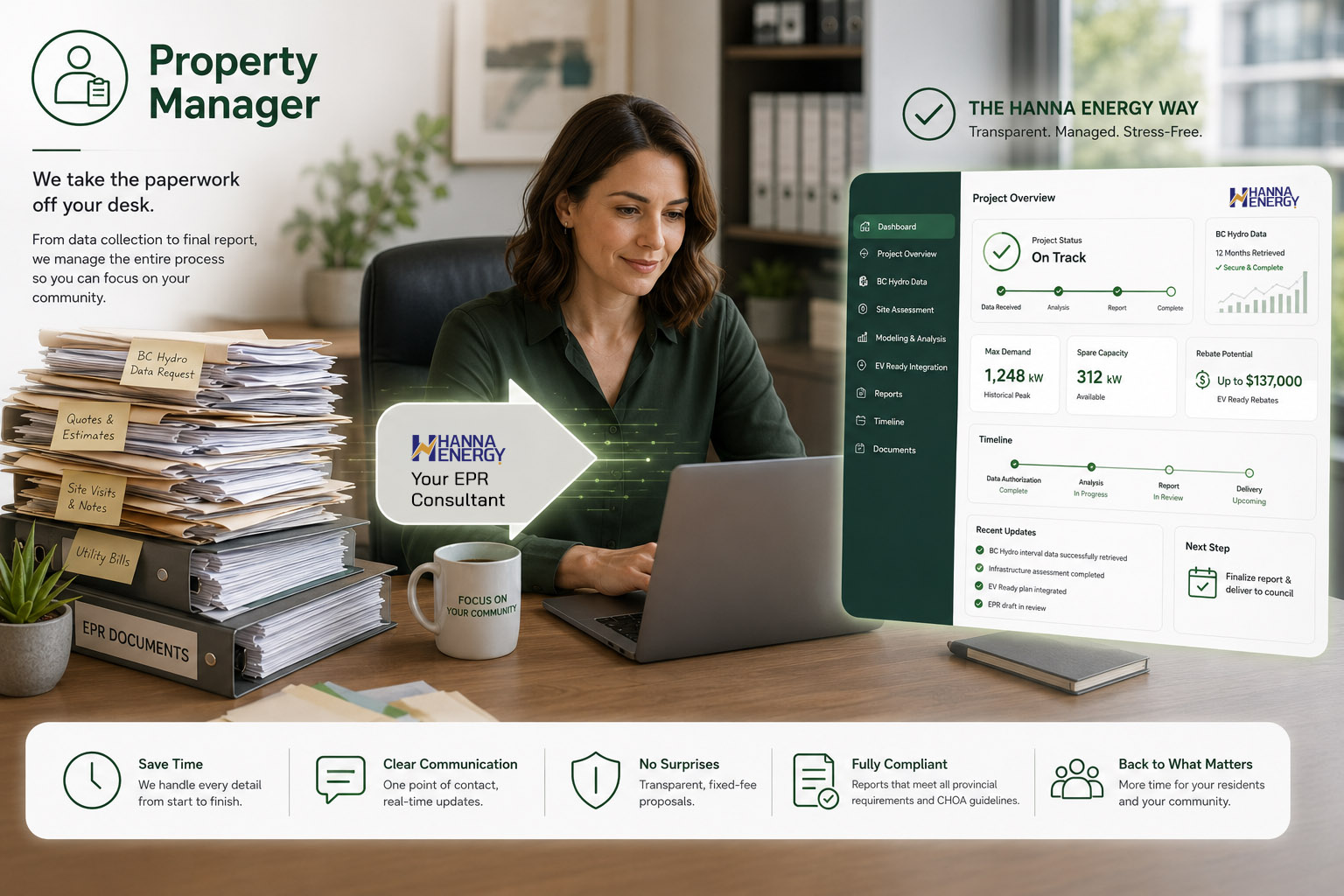
Take the paperwork completely off your desk. We don't do blind quotes that lead to unexpected cost overruns. Simply send us a signed utility data release, and we manage the entire project from initial BC Hydro interval data extraction to the final certified sign-off.
Faq
The provincial mandate applies to every strata corporation in British Columbia that governs five or more strata lots. This legal threshold directly encompasses residential townhouses, traditional multi-story apartment condominiums, bare-land strata subdivisions, and mixed-use properties. Conversely, any strata development containing four units or fewer is fully exempt from these planning regulations.
The official timeframe for regulatory compliance depends entirely on the geographical location of the strata property within British Columbia:
- December 31, 2026: This deadline applies to all strata corporations located within Metro Vancouver, the Fraser Valley Regional District, and the Capital Regional District, which encompasses the Greater Victoria area.
- December 31, 2028: This deadline applies to all other regional districts throughout the interior, northern, or coastal regions of the province, including remote island communities accessible only via ferry or aviation.
Newly constructed strata developments whose official strata plan was registered at the Land Title Office after December 31, 2023, are granted a rolling extension. The strata corporation is legally required to deliver its initial compliant EPR exactly five years from the official registration date of the original strata plan.
Yes, the statutory requirement for an EPR encompasses commercial strata corporations in full. The governing provincial framework is tied directly to the underlying legal ownership structure of the real estate rather than the specific commercial usage of the facility. If a commercial retail center, office tower, or warehouse facility is divided into five or more separate strata lots, the corporation must complete the report.
Because Hanna Energy executes projects throughout the Metro Vancouver region, the definitive statutory compliance deadline for local commercial and industrial strata properties to finalize their electrical report is December 31, 2026.
Yes, mixed-use buildings must comply with the regulations. In a standard mid-rise concrete structure featuring ground-floor retail spaces and residential apartments above, the combined electrical distribution infrastructure must be fully analyzed under a single, integrated electrical report. Hanna Energy handles the technical coordination between the distinct commercial and residential sectors seamlessly.
If the commercial strata plan was formally deposited at the Land Title Office after December 31, 2023, the development is granted a rolling compliance schedule. The corporation is required to complete its initial electrical report exactly five years from the date of the initial strata plan registration.
Yes, Hanna Energy provides full management of your compliance obligations. Our team oversees the initial structural site review, completes the technical calculations, authors the finalized report, and coordinates directly with qualified professionals to ensure the final document carries all necessary legal signatures required by provincial law. We supply a completely turnkey, audit-ready document while your strata council avoids any administrative strain.
Your strata council simply executes a standard, single-page BC Hydro Data Authorization Form. Hanna Energy utilizes this administrative authorization to securely request and extract 12 months of aggregated peak electrical demand records directly from the utility, ensuring total privacy for individual unit holders.
No, these represent completely separate corporate planning tools. A standard Depreciation Report evaluates the physical degradation, lifespan, and future capital replacement costs of general shared assets such as building envelopes, roofs, elevators, and paved roadways. The electrical report focuses on power capacity limits and distribution infrastructure constraints.
CHOA Bulletin 400-518 is an official Request for Proposal template published by the Condominium Home Owners Association of BC. Strata councils utilize this framework to confirm that the consulting firms they retain to execute their report meet all strict provincial statutory requirements and engineering standards.
While utilizing the template is not an absolute statutory mandate from the provincial government, it is strongly recommended by professional property managers. The framework compels service providers to state explicitly how they will calculate peak demand metrics and model future electrical capacity. Hanna Energy engineers all of its project proposals to align with CHOA criteria.
Hanna Energy goes beyond the baseline CHOA standards by delivering an integrated Engineering, Procurement, and Construction Management approach. For every project, we supply comprehensive 12-month BC Hydro interval data analysis, detailed future capacity forecasting for heat pump and vehicle charging infrastructure, and verified professional engineering sign-offs.
If a council retains an unqualified vendor, the resulting document is legally invalid under the Strata Property Act. The strata remains in non-compliance with provincial law, property sales can be impeded during the Form B disclosure review, and the corporation will be required to fund a second assessment with an authorized firm to achieve compliance.
Every building's electrical vault layout, switchgear configuration, and utility metering arrangement is completely unique. Providing random, blind estimates presents financial risks to the strata corporation and frequently results in unexpected project change orders. We analyze your baseline utility parameters first to provide a guaranteed flat-fee price structure.
We provide property managers with a comprehensive Pre-Qualification Package prior to receiving a formal proposal request. This package confirms our active WorkSafeBC standing, our certified BC Hydro Alliance membership, our active provincial electrical licenses, and our conformity with the latest technical standards issued by the province.
EPCM represents Engineering, Procurement, and Construction Management. It identifies Hanna Energy as a specialized firm that oversees your entire compliance path, handling utility data extraction, managing professional engineering validation, and providing a completely turnkey final report.
Yes, as an official member of the BC Hydro Alliance, Hanna Energy is fully authorized to interface directly with the utility provider. This credential enables our team to securely handle your historical consumption data and pursue available funding opportunities on behalf of your strata corporation.
Once a property manager or strata council representative delivers a signed single-page BC Hydro Data Authorization Form, our analysts extract the baseline utility profile and deliver a guaranteed, flat-fee project proposal within 48 hours.
The initial step is to contact Hanna Energy to obtain our streamlined building intake form and the standard utility data release document. Our team assumes the administrative responsibilities immediately, initiating the data retrieval phase for your property.
Property managers must verify registration to prevent strata councils from inadvertently executing contracts with vendors who will nullify their rebate eligibility. Validating a contractor's HPCN status prior to commissioning the electrical report ensures the strata corporation maintains a fully funded path forward when physical upgrades begin.
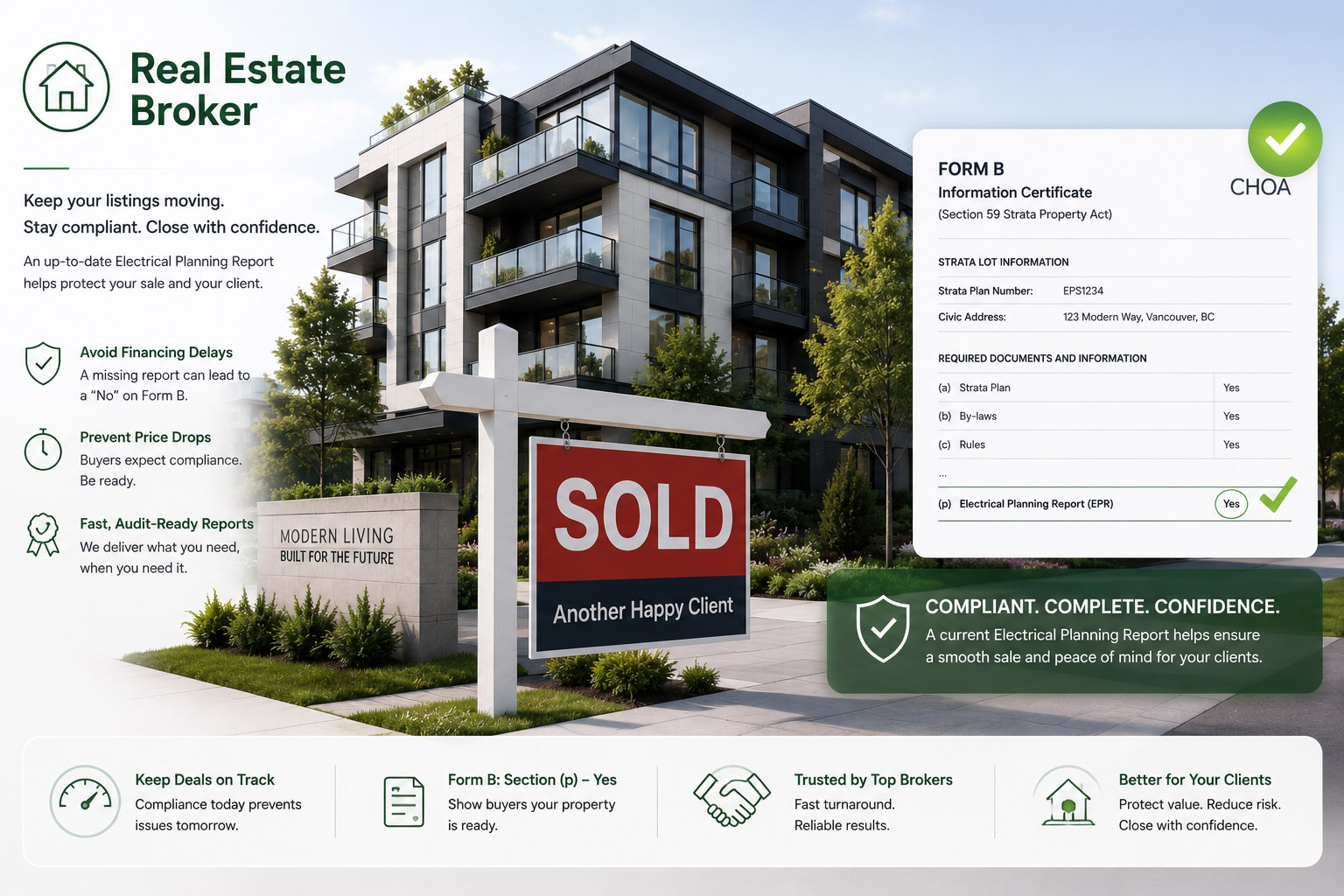
Keep your upcoming townhouse and condo listings clean. A missing report after the December 31, 2026 deadline forces a "No" on Section (p) of the Form B Information Certificate. This simple non-compliance can instantly stall financing or trigger aggressive price drops from buyers. Partner with us for rapid, audit-ready compliance reviews.
Faq
Failing to secure a completed EPR within the specified regional timeframe places the strata corporation in immediate non-compliance with provincial legislation. Real estate legal professionals look for this missing documentation during property transactions, which can delay, complicate, or entirely disrupt individual unit sales because the completed report must be legally disclosed to prospective buyers within the standard property documentation.
Once the report is finalized, it stands as an permanent legal document within the corporate records of the strata. The strata council must explicitly check the affirmative box on section (p) of the statutory Form B Information Certificate and physically append the complete electrical report to the informational package distributed to potential buyers, financial lenders, and property inspectors.
Failure to obtain the mandatory report places the commercial strata corporation in immediate breach of the Strata Property Act. This status of non-compliance is visible on the compulsory Form B Information Certificate, which can prevent, delay, or completely invalidate commercial real estate sales, commercial refinancing applications, or commercial lease assignments within the building.
Review our data standards. We strictly follow the May 2026 provincial guidance updates. Our reports are built on advanced 12-month BC Hydro interval data modeling and complex future load forecasting, completely backed by specialized professional Errors and Omissions consulting insurance.

Faq
Generally, no. While day-to-day service electricians are skilled at performing physical field repairs and electrical maintenance, they rarely hold the specialized professional consulting insurance needed to execute data-driven mathematical load forecasting and demand calculations. Hanna Energy handles the entire quantitative modeling phase and secures the necessary certified professional signatures to complete the document legally.
Not at all. The field evaluation conducted for the report involves zero power outages and requires no entry into private individual residences or active commercial business spaces. The entire physical assessment is performed exclusively within common property spaces, main electrical vault rooms, and shared parking facilities.
An EV Ready Plan is focused solely on the specific wiring layouts, infrastructure designs, and civil costs required to deliver charging capabilities to individual parking spaces. Conversely, an Electrical Planning Report evaluates the comprehensive capacity and systemic health of the entire building, analyzing heating infrastructure, air conditioning, domestic appliances, and vehicle charging loads collectively.
Yes, provided the community shares ownership of any electrical infrastructure. If a bare-land strata development owns even a single shared electrical asset, such as an automatic security gate, shared roadway lighting, or a communal water pump facility, a Full-Form electrical report is legally mandatory.
The Short-Form version is a restricted declaration reserved solely for strata configurations where every individual home receives its power through a completely separate utility connection directly from BC Hydro, and where the strata corporation itself holds zero utility meters and zero shared electrical infrastructure assets.
If your distribution infrastructure is fully utilized, the finalized report will outline specific Demand Management Strategies. Hanna Energy specializes in engineering smart energy control parameters. We show your council how to deploy intelligent control systems to integrate new electrical loads safely, avoiding an expensive physical transformer replacement from the utility provider.
An intelligent load-sharing network is an automation framework that tracks the real-time electrical demand of a building. The system pauses or throttles power delivery to non-essential loads, such as vehicle charging stations, during peak household windows when cooking and heating demands are highest, and restores full delivery overnight when the building's base load drops.
A standard maintenance electrician possesses excellent skills for physical field troubleshooting and repairs, but rarely owns the specialized analytical software or the mandatory consulting insurance needed to perform predictive mathematical load modeling. The legislation states that the report must be written by professionals qualified to model long-term energy utilization trends.
Under Section 5.11 of the provincial regulations, the authoring firm must maintain specialized professional Errors and Omissions consulting insurance, alongside standard WorkSafeBC coverage and Commercial General Liability policies. Hanna Energy ensures every completed report is fully backed by the necessary Errors and Omissions policy to safeguard your strata corporation.
If a service provider miscalculates the remaining capacity of a building within the report, the strata could experience a systemic overload of its primary transformer when residents introduce new mechanical loads. Errors and Omissions coverage insulates the strata from the massive financial liabilities associated with faulty engineering forecasts, which standard commercial liability policies do not cover.
To determine the true remaining capacity of a building, Hanna Energy extracts an entire year of hourly electricity consumption data directly from the utility provider. This granular interval data guarantees that the report identifies the absolute peak winter load experienced by the complex, protecting the property against system overloads.
No, the physical site assessment is conducted entirely within common property electrical rooms, main mechanical vaults, and shared parking zones. Your individual residents face zero disruption, and our technical staff do not require access to private residential spaces.
The updated provincial directives place greater emphasis on the precise forecasting of future electrical loads associated with zero-emission transportation mandates and clean heating initiatives. Hanna Energy incorporates these updated statutory metrics directly into your report to ensure full alignment with the province's long-term environmental targets.
No, attempting to guess future infrastructure demands without mathematical algorithms can lead to blown main fuses, equipment damage, and serious safety hazards. The report provides the precise data modeling required to govern multi-vehicle charging profiles across the entire facility safely.
Yes, if your property has exhausted its available capacity, the report will clearly document the specific technical shortfall. However, Hanna Energy focuses on smart load-sharing software implementations and proactive demand strategies to help your strata avoid the heavy costs of a physical utility transformer replacement.
Yes, Hanna Energy maintains full, active electrical licensing within the province of British Columbia and carries comprehensive WorkSafeBC coverage. This ensures that all physical on-site field work required for your report is performed by fully credentialed and insured local technical specialists.
The Home Performance Contractor Network, or HPCN, is a vetted registry of specialized contractors trained to implement energy-efficient, low-carbon building solutions throughout British Columbia. These specialists have completed advanced qualification tracks covering precise thermal dynamics and building envelope performance. Hanna Energy is a certified HPCN member, ensuring all recommended infrastructure pathways conform to provincial standards.
While an HPCN credential is not a statutory requirement to author the baseline compliance report, retaining an HPCN-certified firm like Hanna Energy is a strategic advantage. Because our teams undergo formal training in complex heat load metrics, we can project the exact electrical capacity your building will require when individual owners substitute legacy systems with advanced heat pumps, preventing electrical infrastructure failures.
Yes, provided they hold the correct provincial credentials. Many standard electrical consultants focus strictly on engineering reports but lack the practical HPCN qualifications required to install rebate-eligible equipment. Hanna Energy operates as a full EPCM provider, meaning we author your report and serve as your certified installer, keeping the entire project workflow under a single vendor.
Yes, all registered HPCN members are required to pass specialized training modules focused on the comprehensive house-as-a-system philosophy, which includes executing accurate heat loss and heat gain engineering calculations. This specialized training is vital when evaluating future building load projections for your report.
The requirement was introduced very recently. As of June 1, 2026, all solar energy arrays and matching battery storage systems must be installed by a registered Home Performance Contractor Network member for the customer to maintain eligibility for BC Hydro utility rebates.